Tuesday, May 13, 2014

The names, the names


Already in the first chapters they are there, the names, the main character Tsukuru's friends: Akamatsu, Ōmi, Shirane and Kurono. The four colourful friends. Red pine. Blue sea. White root. Black field. But nicknamed just Aka, Ao, Shiro and Kuro – Red, Blue, White and Black. The names, and colours, play an important role in the book, all the covers designed so far, have used the colours as their theme, and the colorful characters are introduced already in the first chapter:

また多崎つくる一人を別にして、他の四人はささやかな愚然の共通点を持っていた。名前に色が含まれていたことだ。二人の男子の姓名は赤松と青海で、二人の女子の姓は白根と黒埜。多崎だけが色をは無縁だ。

What to do with them in translation? In Polish and Dutch it seems they have been translated into local names. In German, the names are retained, but explained.

Allerdings hatten die anderen vier eine weitere zufällige Gemeinsamkeit, die Tsukuru Tazaki als Einziger nicht teilte. In jedem ihrer Nachnahmen kam eine Farbe vor. Die beiden Jungen hiessen Akamatsu – Rotkiefer – under Oumi – blaues Meer. Die beiden Mädchen Shirane – weisse Wurzel – und Kurono – schwarzes Feld. Nur der Name Tazaki beinhaltete keine Farbe …

Ursula Gräfe, the German translator, goes on to keep the nicknames of the four as they are: Aka, Ao, Shiro and Kuro, the standard Japanese words for the four colours in question. In Norway we are two people collaborating on the translation, and we are debating what to do.


I am inclined to use Norwegian colour words, but I am far from sure. My co-translator Magne Tørring is strongly against it. Using Norwegian names will pull the book in the direction of a fantasy novel or a childrens' story. It just seems puerile, and as such, does not suit the style of the book, nor its content. Morover, having characters with Norwegian names living in the middle of Tokyo is simply not believable. He maintains.

But then, on the other hand, the Norwegian – or Polish or English – reader will not associate any colours with the words "Aka", "Ao", "Shiro" and "Kuro", no matter how many times their meaning is explained to them. They will not see the colours for their inner eye they way they will when reading the words "Red", "Blue", "White" and "Black". And the colours are significant – colours – or lack thereof – give the book its title, colours define the main character's sense of self – or lack thereof. Why cancel this out, keep it away from the reader? Just for fear of sounding childish?


While the names of the four friends are written with kanji, the nicknames are written in katakana, the phonetic syllabary used for emphasis, foreign loan words, and zoological and botanical expressions. The names stand out, they are singled out typographically with the Japanese version of inverted commas, and on the page look quite different from the name Tsukuru.

Still not convinced, I remember that the Swedish translation is supposed to be out about now. I find it, download it and check it out. Good old Yukiko Duke has come up with a compromise: "De båda killernas namn var Akamatsu – Rödtall – och Oumi – Blåhav, de bådatjejernas var Shirane – Vitrot – och Kurono – Svartäng." she writes, following Ursula German in first transcribing the names and then adding a translation or explanation. But henceforth when referring to them by their nicknames, she translates the nicknames into Swedish colours: Röd, Blå, Vit, Svart. It works. Two pages in, I am convinced. This is no childs' play.

I need to have another discussion with my co-translator. 

Ika Kaminka
Norway


Saturday, May 3, 2014

Colorless Tsukuru Tazaki interview by Publishers Weekly

 Colorless Tsukuru Tazaki and His Years of Pilgrimage

Haruki Murakami, trans. from the Japanese by Philip Gabriel. Knopf, $25 (400p) ISBN 978-0-385-35210-9
Murakami’s (1Q84) latest novel, which sold more than a million copies during its first week on sale in Japan, is a return to the mood and subject matter of the acclaimed writer’s earlier work. Living a simple, quotidian life as a train station engineer, Tsukuru is compelled to reexamine his past after a girlfriend suggests he reconnect with a group of friends from high school.
...
The result is a vintage Murakami struggle of coming to terms with buried emotions and missed opportunities, in which intentions and pent up desires can seemingly transcend time and space to bring both solace and desolation. (Aug.)
You can read the whole review here


Tuesday, April 22, 2014

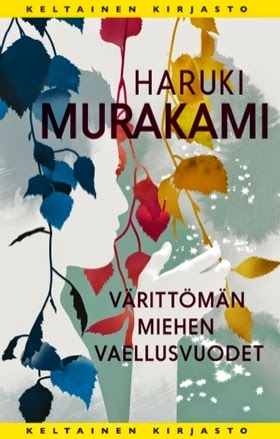
French and Finnish Covers

The French and Finnish covers of Tsukuru Tazaki translations were released on Curtis Brown website.  The Finnish translation is already available for preorder, but the French Amazon site only offers the English and German language editions so far.
Here is what the two covers will look like:


According to the entry on the page of the Finnish publisher, Tammi the Finnish version of Colorless Tsukuru Tazaki is the first translation of a Haruki Murakami's work from the original Japanese. The translator is Raisa Porrasmaa, a scholar, writer and translator living in Japan. As is clear from the cover, the Finnish title does not use the name "Tsukuru Tazaki," but it simply calls refers to a "colorless man." Another page on the publisher's site refers to the fact that a considerable part of the book takes part in Finland, Helsinki and Hämeenlinna, which will no doubt generate additional interest in Finland. 
Both language versions are to appear in September. 

Monday, April 21, 2014

Interview with Dmitry Kovalenin, Russian translator of Murakami


Here is an interview with Dmitry Kovalenin, the Russian translator of Haruki Murakami's works. It was posted on April 18. Kovalenin talks about the new book, about his meetings with the writer and his views on Murakami's works. 


Переводчик Харуки Мураками Дмитрий Коваленин: Мураками - человек, победивший страх

Востоковед Дмитрий Коваленин рассказал "ВМ" японском писателе Харуки Мураками.


Новая книга японца Харуки Мураками «Мужчины без женщин» поступила в продажу в Японии. Продажи начались в полночь, в одном из крупнейших в Токио книжных магазинов «Кинокуния». В это время у его дверей можно было наблюдать традиционную картину: очередь из поклонников писателя, надеющихся быть в числе тех, кто купит его новую книгу первым.
О том, в чем причина такой популярности писателя, мы поговорили с его бессменным переводчиком, востоковедом Дмитрием Ковалениным.
- Дмитрий, вы знаете о том, что в Японии выпустили новую книгу Харуки Мураками – сборник новелл «Мужчины без женщин»?
- Да, и там уже давка невозможная в магазинах. Я помню, как еще в прошлом году, перед началом продаж его предыдущей книги, люди занимали очередь еще ночью. Так что это, похоже, становится традицией. В новой книге шесть новелл и каждая о мужчине, которой расстался с женщиной, но потом осознал, что он ее, оказывается, любил. Эта тема у него всегда очень бережно обыгрывается, поэтому можно ожидать каких-то интересных этюдов. А поскольку они объединены в одну книгу, то лично мне будет интересно посмотреть его комбинаторику. Мураками умеет прекрасно комбинировать вещи, выстраивая логику, как в музыкальном альбоме.


Подробнее:http://vm.ru/news/2014/04/18/perevodchik-haruki-murakami-dmitrij-kovalenin-murakami-chelovek-pobedivshij-strah-245005.html

Подробнее:http://vm.ru/news/2014/04/18/perevodchik-haruki-murakami-dmitrij-kovalenin-murakami-chelovek-pobedivshij-strah-245005.html

Thursday, April 17, 2014

The New Short Story Collection Released at Midnight

The new short story collection by Haruki Murakami titled "Onna no inai otokotachi" was released at midnight in some Tokyo bookstores. The title was perhaps inspired by Hemingway's 1927 short story collection Men Without Women. The image of the cover appeared on the Japanese Amazon site just a few minutes after midnight. The collection includes 6 stories, 5 of them published previously in literary magazines and the title story (for details and titles see the post of March 15). According to some internet sources the first print run will be 300 thousand copies.


Pictures of the first happy buyers can already be found on the internet:


The article reports that the release was preceded by an event called "Biburiobatoru" (Biblio Battle?) where people "talked about Haruki Murakami's work." However, given that the event had a winner and was called a "battle", it must have been some kind of a contest rather than a discussion. The winner was a 32-year-old company employee, Mr. Hayakawa who was given the right to buy the first copy of the new book. Having looked at it briefly he said: "The writing style has charm. Last year was a full-full length novel [referring to Tsukuru Tazaki] so I wasn't able to read it overnight, but tonight I want to read the new story before going to bed." 
Apparently there was a countdown before midnight and at 12am a group of fans set off fire crackers in front of the Shinjuku Kinokuniya. 

Here is a link to an article in Asahi Shinbun covering the event.


Tuesday, April 15, 2014

Philip Gabriel Speaks To Times of India on Translating Murakami and Tsukuru Tazaki

The Times of India recently published an interview with Philip Gabriel, who is translating Colorless Tsukuru Tazaki into English. The interviewer was Ipshita Mitra and the interview was originally published on March 6, 2014.

Here is an excerpt:

Philip Gabriel on translating Haruki Murakami
,TNN | Apr 8, 2014, 12.00 AM IST

Murakami, a writer 'found in translation'
Haruki Murakami is a translator himself and has translated American writers like F. Scott Fitzgerald, J. D. Salinger, Raymond Carver and John Irving into Japanese. "Murakami understands and appreciates the challenges of working between English and Japanese. He is always generous with his time. When I have questions, I run these by Murakami via email and he responds quickly to any parts I have trouble with. Murakami and/or his staff read through the first draft of my translations and make suggestions and changes," says Philip. 

Murakami's works have been translated into more than 40 languages and have featured on the bestselling lists across the world, from South Korea to Australia, Italy, Germany and China. 

Would it be correct to assume Murakami as a writer 'found in translation'? 

"If it means he is best approached or understood in translation, I would have to disagree. If it means he has more readers who read him in translation than in the original Japanese, I am not sure if this is accurate, but wouldn't be surprised if it is, since he has been translated into so many foreign languages," argues Philip.

Longer excerpts can be found on the Times of India website, and the whole interview can be found on Ipshita Mitra's Wordpress site.

Tuesday, April 1, 2014

Haruki Murakami an "International Bestseller"?

A grand announcement for the English translation of Tsukuru Tazaki appeared on the Random House page (see the announcement here). It calls Haruki Murakami an "international bestseller," which seems a little unusual to me (shouldn't it be "international bestselling author"?). The whole blurb appears to have been written in a hurry. The price is given as $25 (compared to $18.63 on Amazon).


On another note, Publishing Trends announced international bestseller lists for March 2014 from France, Germany, Italy, Spain, Austria and Brazil. It looks like Tsukuru Tazaki made it to the top ten in Austria.


Tuesday, March 18, 2014

French Translation of Colorless Tsukuru Tazaki to Appear in September

The French translation of Colorless Tsukuru Tazaki is to appear on September 4th from Belfond. It was announced a month ago (see the article here), but somehow I missed it. The French title will be  L'incolore Tsukuru Tazaki et ses années de pèlerinage. It seems that the cover design has not been released yet. 
logo
Here is another article on the topic:
http://culturebox.francetvinfo.fr/le-nouveau-roman-de-murakami-arrivera-le-4-septembre-en-france-149851

Honorary Degree For Haruki Murakami


Tufts Now, the Tufts University gazette, has just announced that Haruki Murakami will be awarded an honorary degreee.

Haruki Murakami, novelist.  Acclaimed not only in his native Japan but also internationally for fiction that is humorous and surreal, Murakami has earned numerous literary prizes and been praised as being "among the world's greatest living novelists" by The Guardian. Murakami will receive an honorary doctorate of letters.  - See more at: http://now.tufts.edu/news-releases/anne-marie-slaughter-deliver-tufts-commencement-address-may-18#sthash.uAB9YZZY.dpuf


To see the whole article go to: 

Monday, March 17, 2014

An Interview with Norihiro Kato about Colorless Tsukuru Tazaki

Norihiro Kato, professor of literature at Waseda University and a well-known critic who has written a great deal about Haruki Murakami (including the famous two-volume study, Murakami Haruki Yellow Pages), was interviewed by Hiroshi Matsubara from AJW (Asahi Shinbun Asia & Japan Watch) about Colorless Tsukuru Tazaki. 
Kato talks about the issues of commitment and detachment, which are often discussed in the context of Murakami as a writer. He also describes how his impressions of the book evolved as he read it three times!  He calls the novel "an imperfect novel that needed to be written as such to allow the author to reach a new paradigm."

INTERVIEW/ Norihiro Kato: 'Colorless Tsukuru Tazaki' is an imperfect work but one of Haruki Murakami's most important

photo by H. Matsubara

Editor's note: This interview is part of The Asahi Shimbun AJW's series on internationally acclaimed writer Haruki Murakami.
* * *
When he first conducted his cover-to-cover structural analysis of Haruki Murakami’s latest full-length novel, “Colorless Tsukuru Tazaki and his Years of Pilgrimage,” Norihiro Kato realized he would not rank this work with the author's best.
But as he read the novel a second, and then a third time, the Waseda University professor recognized its importance as a possible turning point in the acclaimed writer's literary career.

Saturday, March 15, 2014

EXTRA! EXTRA! READ ALL ABOUT IT!
It was announced today that Haruki Murakami will publish a new short story collection almost exactly a year after Colorless Tsukuru Tazaki hit the bookstores. The collection, titled Onna no inai otokotachi ("Men Without Women"? "Womenless Men"?  The site ajw.asahi.com gives the title as the somewhat awkward "Men Who Do Not Have Girlfriends"), consists of five or six (depending on the source) stories, all but one of which have previously been published.

Here is the list of six stories, based on information provided in the sankei.jp article:

収録するのは、書き下ろしの表題作と、総合誌「文芸春秋」に掲載した「ドライブ・マイ・カー」「イエスタデイ」「独立器官」「木野」、文芸雑誌「MONKEY」(スイッチ・パブリッシング)に発表した「シェエラザード」の計6編。
(For readers who don't read Japanese, the stories are: 1) the previously unpublished title story, 2) "Drive My Car," 3)"Yesterday," 4) "Independent Organ" [?], 5) "Kino," all of which have appeared in Bungei Shunju and 6) "Scheherezade," which appeared in Monkey.

Here is a link to the ajw.asahi.com article article in English (which mentions only five stories). 

The book can already be ordered on amazon.co.jp and is already listed as a "Number 1 bestseller"!


女のいない男たち 村上 春樹 (2014/4/18)

Wednesday, March 12, 2014

Ursula Gräfe Interviewed and the German Translation of Tsukuru Tazaki Nominated for a Prize

I have come across an interview with Ursula Gräfe, the German translator of Tsukuru Tazaki. It seems that the book has been nominated for the Lepizig Book Fair Prize. Congratulations to Ursula! The winner is to be announced tomorrow. I am keeping my fingers crossed!


In the interview Ursula talks about how she became a translator and a little about her approach to translating from Japanese.

Here is a fragment: (readers who don't speak German can use our handy Translate app on the right)


Ursula Gräfe wurde 1956 geboren und hat Japanologie, Anglistik und Amerikanistik studiert. Seit 1988 arbeitet sie als literarische Übersetzerin und wurde vor allen Dingen durch ihre Übersetzungen der Romane von Haruki Murakami bekannt. Zuletzt übersetzte sie seinen neuesten Roman “Die Pilgerjahre des farblosen Herrn Tazaki” – mit ihrer Übersetzung wurde sie für den Preis der Leipziger Buchmesse nominiert, der am 13.03. vergeben wird.
Sie sind bekannt geworden als Übersetzerin von Haruki Murakami – was verbindet Sie mit Japan und warum haben Sie sich entschieden Japanologie zu studieren? 
Meine Entscheidung, Japanologie zu studieren, entsprang eher der Neugier als einem besonderen Interesse oder einem festen Plan. Damals hatte ich nicht die geringste Ahnung von Japan, ganz zu schweigen von japanischer Literatur. Vor allem wollte ich gern eine asiatische Philologie studieren, um mein Bild von der Weltliteratur zu erweitern. Später, als ich Japaner kennen lernte und begann, japanische Literatur zu lesen, eröffnete sich mir eine unbekannte neue Welt, und ich fing richtig Feuer. Die ersten Werke, die wir im Original lasen, sind mir unvergesslich. Es waren Shunkinsho – Die Biografie einer Frühlingsharfe von Jun’ichiro Tanzaki – da könnte man auch mal an eine Neuübersetzung denken – und Kappa von Ryunosuke Akutagawa. Beides war unbeschreiblich schwer. Wir haben so unendlich lange für jeden Satz gebraucht, dass das Seminar über die ganzen Sommerferien ausgedehnt werden musste.

To read the whole interview go to: http://buzzaldrins.wordpress.com/2014/03/11/ursula-grafe-im-gesprach/

Also, at this addresses you can find reviews of the book:
http://www.zeit.de/video/2014-01/3116020455001/haruki-murakami-lesetipp-von-iris-radisch-die-pilgerjahre-des-farblosen-herrn-tazaki
http://www.spiegel.de/kultur/literatur/haruki-murakami-die-pilgerjahre-des-farblosen-herrn-tazaki-a-942398.html

Thursday, February 20, 2014

Lithuanian Cover of Tsukuru Tazaki Released

Curtis Brown Agency representing Haruki Murakami in Europe has posted the Lithuanian cover of Colorless Tsukuru Tazaki. It is interesting to notice Tsukuru's Lithuanian name: Cukuru Tadzakis!


http://www.curtisbrown.co.uk/haruki-murakami//gallery/

Wednesday, February 19, 2014

"First Stage" of the UK Cover of "Colorless Tsukuru Tazaki" Revealed

Harvill Secker/ Vintage books revealed yesterday the "first stage" of the cover design for the British edition of the novel. This cover, like the US one, seems to be inspired by the four colors symbolizing Tsukuru's friends, but seems a little more imaginative. One wonders what the "final stage" will be like. 

The designer, Susanne Dean said: "Stage one of the cover reveals an elegant abstract design, representing the five main characters and close childhood friends Mr. Red, Mr Blue, Miss White, Miss Black and Colorless Tsukuru Tazaki. Tsukuru means to make or build, and this is an integral part of the second stage of our cover to be revealed at a later date.’ The book is to come out on August 12. 


Tuesday, February 18, 2014

The American Cover of Tsukuru Tazaki

The cover of the American edition of Tsukuru Tazaki was released by Random Hourse and appeared on amazon.com.  It seems that the designer (his or her name is not listed) has taken the color theme rather literally. The four color strips seem to represent Tsukuru's four friends: Aka, Shiro, Kuro and Ao.  There is also a rectangular element, which seems to have been cut out from a map of Tokyo area train network -- no doubt a bow towards Tsukuru's interest in trains and train stations.