Sunday, April 19, 2015

More on Translating Images and The Strange Library

When talking about translations of Murakami and illustrations, one has to mention the German illustrator Kat Menschik (in the picture below), who worked on The Strange Library, among other Murakami writings. The drawing on the right shows Murakami and Menschik together (although she doesn't look like herself...).


In the previous post, I wrote about the illustrations in the British and American version of The Strange Library.  The story came out in German a year earlier, in 2013, in Ursula Gräfe's translation, Die Unheimliche Bibliothek, illustrated by Menschik. Menschik had earlier done the illustrations for three other Murakami stories: Schlaf ("Sleep," 2010, translated by Nora Bierich)  and Die Bäckereiüberfälle (which consists of two short stories, "The Bakery Attack," and "The Second Bakery Attack," 2012, translated by Damian Larens). While the first of these (The Strange Library/ Fushigi na Toshokan) was also an illustrated book in Japanese, the other three stories were not, and appeared in short story anthologies.


It would be worth thinking about the relationship between illustrations and the translated text: What new qualities do they add to the story? Do they detract from the story or help us enjoy it more? Do they make concrete something the author intended to leave vague?  In the case of stories that were originally accompanied by illustrations, why not use those? Do illustrations have to be "translated," too?  In the case of stories that originally lacked illustrations, what does it mean to add that element? 

Menschik's illustrations, as is already clear from the cover of the Die Unheimliche Biblioteque, are quite different in style from the original ones by Maki Sasaki. Below left is a picture showing both editions of The Strange Library. On the right is an illustration of the German version of Sleep, which was not illustrated in the original. 


All three stories were re-published in Japan with Menschik's illustrations. What is interesting is that the title of the Strange Library went back to the original 1982 title, Toshokan kitan (Strange Tales of a Library), and the title of Bakery Attacks ("Pan'ya Shūgeki" and "Pan'ya saishūgeki") became something like "To Attack a Bakery (or Bakeries)" ("Pan'ya o osou"). It may be the case, of course, that the Japanese version IS in fact a new edition of the original story, which was much longer. (I will order it and report.) Below are the only two illustrations included with "Toshokan kitan" in the 1983 anthology, titled Kangarū-biyori:


Below are the covers of the Japanese editions of Toshokan kitan (2014, Strange Tales of a Library), Pan'ya o osou (2013, To Attack a Bakery) and Nemuri (2010, Sleep), all with Menschik's illustrations:


Menschik's illustrations clearly are admired by many, since the Spanish edition of the Strange Library (or rather: Secret Library) (2014, Lourdes Porta, tr.) and the French edition of Bakery Attacks (2012, Corinne Atlan, Hélène Morita, tr.) also used her images:


The same is true of the story Sleep, which came out with Menschik's images in French (2010, Corinne Atlan, tr.), Spanish (2013, Lourdes Porta, tr.), and Italian (2014, Antonietta Pastore, tr.) It is worth noting that in both Spanish translations Lourdes Porta got her name on the cover! 


Translating Images


I have been thinking lately about the role illustrations play in a translation. Last December I read an article by Roland Kelts titled "Illustrating Murakami." It talks about Chip Kidds illustrations for the American version of The Strange Library.

When talking about translations, we tend to focus on the text.  Sometimes a cover gets mentioned in a review, but that's about it -- usually we don't discuss illustrations, since most books for adults are not illustrated. In the case of Murakami's The Strange Library, however, published in Ted Goosen's English translation last December, the illustrations deserve special attention.

This book was originally a longish short story titled Toshokan kitan (Strange Tales of a Library) published in six parts in 1982.  The story was later somewhat rewritten and came out in 2005 as an ehon (an illustrated book) titled Fushigi na toshokan (The Strange Library).  (You can read more about this story's history in the post from September 6, 2014.)

The illustrator for the 2005 book was Maki Sasaki. The British edition (Harvill Secker, 2014) was designed and illustrated by Suzanne Dean, and the American edition (Knopf, 2014) was designed by Chip Kidd.  All three are pictured below.


One look at the three covers makes it clear that we are dealing with three very different books. The Sheepman (Hitsuji otoko) featured amongst flying donuts on the Japanese cover gives a fun, whimsical impression. The  British cover -- complete with an actual sleeve for holding old-fashioned library cards, covered with stamps, the last one saying 2 DEC 2014, the date of publication -- is simple and unusual, but doesn't give anything away. The American cover actually unfolds (it is held together by a seal-like sticker bearing the number 107) to show the first sentences from the book, written in large font that looks like an old typeface. In other words, we start reading the book (enter the library?) before we have even had a chance to turn a single page.


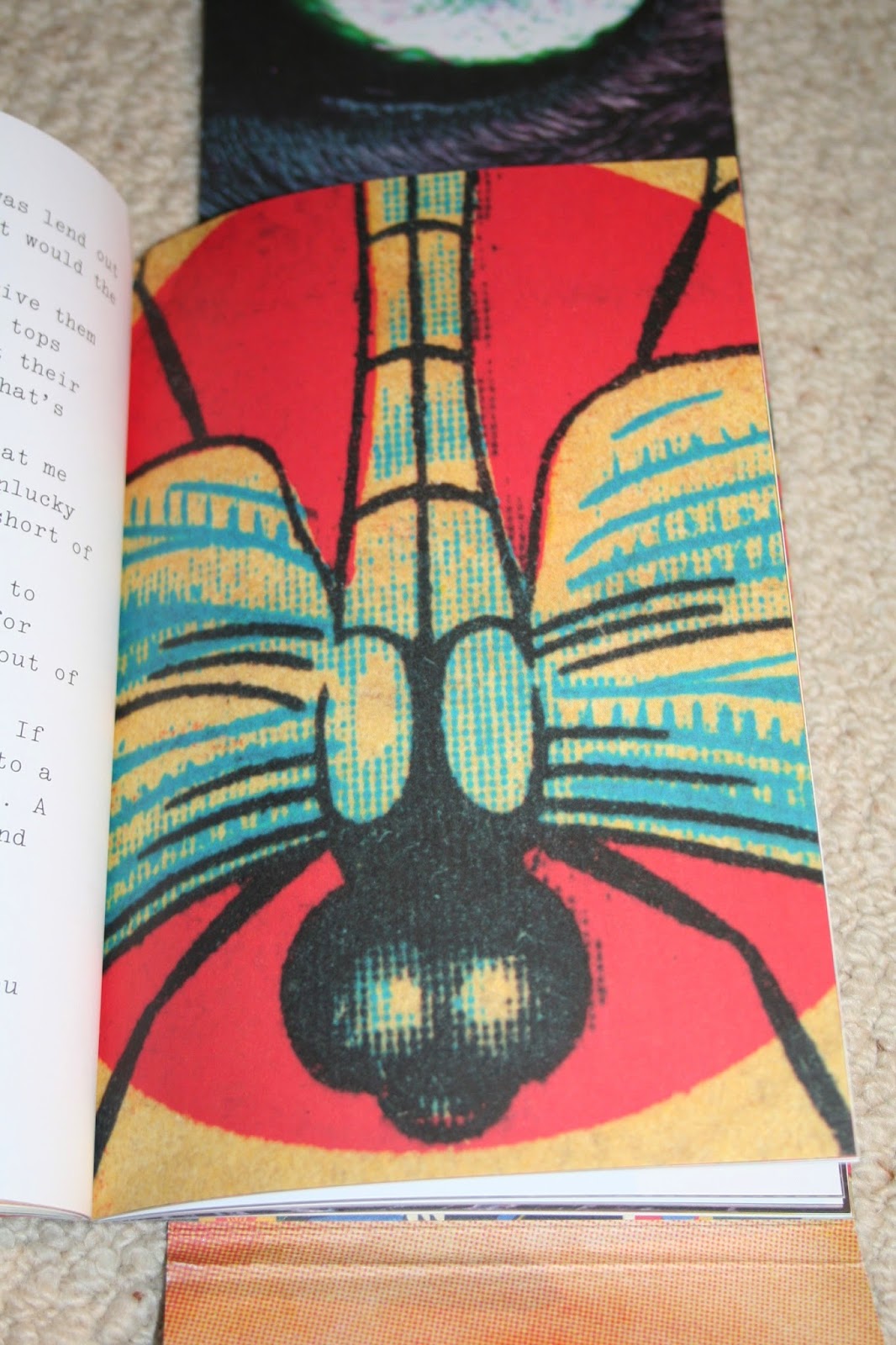
That feeling of dealing with different books only deepens as we turn the pages.  Generally speaking, the British edition is full of beautiful old pictures, apparently found by the designer in the London Library (see the post from September 25th), including old drawings of insects, dogs, tea cups, etc.

The Chip Kidd version is more abstract.  Some pictures appear to be close-ups, many with definitely Japanese elements, which are completely absent from the original pictures by Sasaki. Two examples featured below show how the story, describing a travel into the protagonist's Jungian-style psyche, has been orientalized in its American version:


I see no good reason to include this type of image, perhaps except for the illustrator's or publisher's belief that you have to have something Japanese in a Japanese book.

Let's look at two further examples of differences in the three illustrators' visions of the book's imagery.

1. There are a few mentions of bugs in the book. The first has to do with small black bugs "scratching about on the underside of the lampshade" in the old man's room. The second comes in a comment made by the Sheepman (or sheep man, as Ted Goossen calls him) who, answering the question whether he can help the protagonist get out of the library, responds: "If I did that, I would be chucked into a jar full of hairy caterpillars. A big jar, with about ten thousand of the buggers crawling around, for three whole days." Let's look at the three sets of bug-related illustrations below:

In the Japanese version, we see flies buzzing around the lamp and the Sheepman in a jar, but the caterpillars are not pictured:


In the British version, we have beautiful prints of insects and caterpillars, which seem more like variations on the theme of bugs than illustrations of the story:


The same is true of the American version:


2. The protagonist is reading A Diary of an Ottoman Tax Collector. Below are the Japanese, British and American illustrations:


The first two are more or less "literal" renditions of scenes from the Ottoman period (the first one done by Sasaki for the original story, the second either an authentic old drawing or else an image created by Dean for this book -- it is impossible to find any information on the source of this image in the book). The third version, by Chip Kidd, portrays a plate or some other decorative element, simply suggesting Turkey. 

My impression is that the pictures in the original are meant to be enjoyed by adults and children, but the British and American ones are addressed to adults, albeit playful adults (more playful in the American case). It makes one think about the very important role illustrations play in the impression the translated book creates. No doubt it has a lot to do with publishers' marketing strategies and the way they envision the profile of a potential reader in each country.

But seeing these very different three versions, one wonders, would The Little Prince have been a different book in English, German, French or Polish translation if it hadn't included Saint-Exupéry's watercolors?

To read about Maki Sasaki (in Japanese), go to:
http://www.art-life.ne.jp/creator/artist_top.php?artist_id=C0091

To read more about Suzanne Dean's designs, go to: http://www.telegraph.co.uk/culture/books/8929045/Suzanne-Dean-the-secret-to-a-good-book-cover.html

To hear and see more about Chip Kidd, go to:
https://www.youtube.com/watch?v=cC0KxNeLp1E
https://www.youtube.com/watch?v=HGunvu4T5kU

Monday, March 30, 2015

Plural? Singular? Translation Problems with "Men Without Women"

I have recently begun translating  Onna no inai otokotachi (2014), and have been talking to other translators who have already finished it about issues that came up for them, among them how to translate the title. The problem is that otokotachi is "men" in plural, but onna is "woman" in singular. 
There are also potential number-related translation difficulties with sentences like:  その世界ではあなたは「女のいない男たち」と呼ばれることになる。(p. 276)

In the preface, Murakami states explicitly the the title is not meant to be a translation of Hemingway's short story anthology, Men Without Women. He says that if he had wanted to translate that title, Onna nuki no otokotachi would have been closer to the spirit of the original. There is also a Japanese translation of the Hemingway's anthology titled Otoko dake no sekai. However, it is worth noting that on the website of Murakami's European agent, Curtis Brown, the title is given as Onna no inai otokotach/Men without Women, as if the English title - identical, in fact, to Hemingway's -- had been decided. Although, as I have said in one of the earlier posts, it is hard to predict whether the book will come out in English as a short-story anthology, since three of the six stories have already appeared in the New Yorker


I haven't decided yet what the Polish title will be, but I will probably opt for something similar to the English, "Men Who Have No Women" or "Womenless Men." In thinking through this, I have been in touch with three translators: Ursula Gräfe (German translation, 2014), Lai Ming Chu (Taiwanese translation, 2014) and James Westerhoven, the Dutch translator,  whose translation is to appear at the beginning of 2016. 


Here is the beautiful cover of the German translation. As you can see, Ursula Gräfe went with "Frauen" in plural, so her title means something like "Of men who have no women." Apparently using "woman" in singular would not have worked in German. I suspect it would not work in Polish, either. 

But James Westerhoven says it is possible to manage this awkward combination in Dutch. He has kindly agreed to share his reflections on this blog :  

"I discussed the Dutch title with the Dutch publisher at some length. At first they were planning to call it Mannen zonder vrouwen (Men without women), because they had the impression that Murakami had written the book with Hemingway’s title in mind, as a kind of homage to the older writer. But after reading his foreword, in which Murakami writes that his title is similar to but his intention different from Hemingway's book, and also after reading the title story, in which the formula ‘mannen zonder vrouw’ occurs regularly in context and in which it would have been grammatically impossible to write ‘men without women’, my editors agreed with me. So the final title is Mannen zonder vrouw, literally: Men without Woman, which of course makes no sense at all in English.

"Let me explain the subtle difference in Dutch. ‘Men without women’ simply states that a number of men are unaccompanied by women. Whether those women ‘belong to’ these men is immaterial, because the women are not really important. That is what Hemingway intended to convey in his title, and that is how the Dutch translator of Hemingway’s book translated the title — and quite properly so. But ‘men without woman’ suggests that several men (say four) all have one woman (so four women), who ‘belongs to’ her man but is absent for some reason. And because all the men in these stories are to all intents and purposes monogamous, they only have one woman, even if they bed more than one."

In case of the Taiwanese translation, the issue was not whether to make the word onna singular, but whether to make otokotachi singular, or rather, unspecified.  Lai Ming Chu, the Taiwanese translator, described it like this: 
"One characteristic of Chinese is that it can use the singular to encompass the plural. When I handed in my translation of Onna no inai otokotachi (Chinese title: Meiyou nüren de nanrenmen 「沒有女人的男人們」), the editor told me that they wanted to remove the pluralizing suffix-men , which would make the title Meiyou nüren de nanren, meaning either “Men Without Women,” “Man Without Woman,” or “A Man Without A Woman,” with no clear sense of singular or plural or definite/indefinite. Indeed, in general, this might be the preferred translation, and would likely be the title if the book had originally been written by a Chinese author. But in this instance, such a translation did not make sense: The title story describes the relationship between two men and one woman, with particular emphasis in the text on the two lonely men. Use of the plural form was thus unquestionably indicated, especially as the short story collection describes several different men (not to mention that the plural suffix –tachi is there in the original Japanese title). Moreover, translating the title as Meiyou nüren de nanrenmen and emphasizing the plural form calls attention to the difference with what would sound “natural” in Chinese, and makes a distinctive impression upon the reader. After some explanation, the editors finally agreed to go along with my suggested title. It was just one word, but it made a big difference."

The mainland Chinese translation of the book, (the cover is pictured on the left) was done by a team of six translators, led by the main Murakami translator, Lin Shaohua.  It is titled exactly the same as the Taiwanese version, and also the same as the Chinese title of Hemingway's Men Without Woman (on the right). 

The Spanish translation appeared this month. It is titled Hombres sin mujeres, that is, "Men without women." As was the case with Tsukuru Tazaki, the name of the translator is not given on the publisher's page:
http://www.tusquetseditores.com/titulos/andanzas-hombres-sin-mujeres, but I have found it on Goodreads. It is Gabriel Álvarez Martínez. 

The book will appear in the Swedish translation by Eiko and Yukiko Duke in May 2015. The title is Män utan kvinnor, which, Google Translate tells me, means "Men without women." 


Friday, February 20, 2015

English Translation of New Murakami Story in this Week's New Yorker

This week's New Yorker (February 23) published a translation of the story "Kino" from Murakami's newest anthology, Onna no inai otokotachi. The story was translated by Philip Gabriel. This is the third of the six stories from the book that has appeared in English: "Yesterday," also translated by Philip Gabriel, was published in June 2014, and "Scheherezade," translated by Ted Goossen, appeared in October.  It makes one wonder if the whole anthology will be translated into English and come out as a book, or whether the remaining three stories will continue appearing in the New Yorker every four months or so.

That it will be done this way seems likely for another reason: English is not listed as one of the languages for which the rights have been sold for Onna no inai otokotachi on the Curtis Brown webpage (Curtis Brown is Murakami's agent for Europe).  Here is the list:


So far, only one short story collection by Murakami appeared "unchanged" in English: after the quake (Kami no kodomotachi wa mina odoru, 2000), which came out in 2002 in Jay Rubin's translation. The other anthologies of Murakami short stories -- The Elephant Vanishes (1993, Alfred Birnbaum and Jay Rubin, trans.) and Blind Willow, Sleeping Woman (2006, Jay Rubin and Philip Gabriel, trans.) -- both included stories selected from several different Japanese anthologies, chosen by the translators and the author.


(The middle illustration is by Merlin, the photographs in the first and third are by Michael Marcelle. )

This is how "Kino" starts: 

To read the whole story, go to: http://www.newyorker.com/magazine/2015/02/23/kino

Friday, January 16, 2015

Murakami Advice Page Opened Today

As was reported by many sources around the world, the Haruki Murakami advice corner website, called "Murakami san no tokoro," opened today.  The address is: http://www.welluneednt.com. The site is illustrated by Masaru Fujimoto.


Under the トップ tab on the left is an explanation from Haruki Murakami about how he suddenly felt like getting in touch with his readers after almost a decade. He promises to glance at all the questions himself (rather than have an editor or assistant do it), but explains that since the site is open to everybody, he expects a lot of questions and will not be able to answer them all. He apologizes to readers who will be disappointed.

There is also a section called 質問はこちら [Have a question? Click here]. After clicking, we find a set of "house rules," which explain that all questions have to come belong to one of four categories. Here they are:


 In English they would be something like this:
1. Questions or advice I want to ask of Mr. Murakami
2. Something I want to tell Mr. Murakami
3. My favorite places, my least favorite places
4. [Things] related to cats or the Yakult Swallows [a professional baseball team]

There is also a limit of length: 1200 characters.
After reading the "House Rules," one can click on  質問を送る[send a question] and after filling in one's "pen name," age, gender, e-mail address, and occupation (not required) one can type in a question. The House Rules also warn that some of the questions and answers will appear on the webpage and may in the future be published, so readers have to be prepared that their "pen names," age, etc. will also be made public.

So how about asking a question?  The whole website is in Japanese.  One may guess that, since he knows English, Murakami may perhaps also consider answering a question asked in English, but that response may well be in Japanese. This does seem to be a unique opportunity to ask a famous writer a question. As far as I know, Murakami is one of very few writers -- perhaps even the only writer of his stature -- who engages in this kind of online exchange with readers.

Some people will no doubt dismiss the whole thing as a marketing trick, but I personally disagree.  It's hard to imagine that Haruki Murakami really needs to worry about getting more publicity: he has a huge number of faithful fans, after all.  At least at first glance (no questions have appeared yet), this website does seem to be exactly what he says it is, a chance to get in touch with readers and find out what is on their minds.

Monday, January 12, 2015

Haruki Murakami Will Respond to Readers Questions Online Starting on January 15

Once again, for the third time - as far as I know - Haruki Murakami will be responding directly to readers’ questions on a webpage, this one to be opened on January 15, as was announced by his publisher, Shinchosha, on January 5.

In the past Murakami has answered readers' questions, most famously on a page opened by Asahi Shinbun called "Murakami Asahido."  According to a January 6 article in Asahi Shinbun, Murakami felt that after a long break, he wanted to interact with readers again, and made a sudden decision to create the webpage, the first time he has done so in nine years.  The website will be called "Murakami-san no tokoro," or, "Mr. Murakami's Place."

This is the announcement on the Shinchosha site: http://www.shinchosha.co.jp/murakamisannotokoro/


The web address has not been released yet, but the announcement makes it clear that the site will be open for a limited time starting "on the afternoon of January 15th." Under the announcement in Murakami's writing (or so we assume) it states: "I am waiting for your questions. Haru." It seems that the readers are encouraged to ask anything, about "their worries, etc."

According to a related article at time.com, the spokesman for Shinchosha said that fans will have until the end of January to ask questions, and Murakami's responses will appear on the website during the following two months, until the end of March. 

In the past, Murakami's exchanges with readers have been published in four books, which are quite interesting and valuable for anyone hoping to get a glimpse of the real person behind the author, who provides answers to questions from people struggling with all kinds of personal problems or asking totally surreal things. Murakami never loses his cool and responds in a witty, kind, and caring way. Here are the covers of the books:


Perhaps this readers' forum will also lead to a similar publication in the future.