The first Chinese translation of Colorless Tsukuru Tazaki is to appear in Taiwan on October 1, 2013.
The translator is Lai Ming-zhu(頼明珠) who has rendered into Chinese practically everything Haruki Murakami has ever written, including his essays (c.f. http://ja.wikipedia.org/wiki/頼明珠). We are happy to see that her name is printed on the cover.
The book can be pre-ordered until today at a discount price. Here are some links: https://www.facebook.com/hurukimurakami
http://www.readingtimes.com.tw/ReadingTimes/ProductPage.aspx?gp=productdetail&cid=rtai09(SellItems)&id=AIA0962A&itemid=86
http://www.books.com.tw/products/0010597873
http://www.readingtimes.com.tw/
http://www.kingstone.com.tw/book/book_page.asp?kmcode=2028611043818
It seems that the book went on sale a few days earlier in Hong Kong (and has already sold a million copies!), which has some Taiwanese readers irate.
This blog is meant as an open forum where translators of Haruki Murakami can share ideas and discuss solutions to problems encountered in the process of translating his works. It was launched by two translators of Murakami into Norwegian and Polish, Ika Kaminka and Anna Zielinska-Elliott. Some of us have collaborated in the past, and many of us are in touch regularly by e-mail, but the publication of the new novel in 2013 served as a catalyst for the creation of an online translation blog.
Monday, September 30, 2013
Saturday, September 28, 2013
Trailer for the Spanish Translation of Colorless Tsukuru Tazaki Posted on the Internet
The Spanish publisher of Colorless Tsukuru Tazaki, Tusquets Editores, posted a trailer for the novel on the publisher's webpage. To see it go to:
http://www.tusquetseditores.com/murakami/
and click on BOOK TRAILER.
or you can watch it here:
http://vimeo.com/75382101
The Spanish translation is to come out on October 15th. The catalogue on the publisher's page lists the book, its price, even the number of pages (320), but the translator's name is not mentioned, which makes us sad.
http://www.tusquetseditores.com/titulos/andanzas-los-anyos-de-peregrinacion-del-chico-sin-color
http://www.tusquetseditores.com/murakami/
and click on BOOK TRAILER.
or you can watch it here:
http://vimeo.com/75382101
The Spanish translation is to come out on October 15th. The catalogue on the publisher's page lists the book, its price, even the number of pages (320), but the translator's name is not mentioned, which makes us sad.
http://www.tusquetseditores.com/titulos/andanzas-los-anyos-de-peregrinacion-del-chico-sin-color
This is the Spanish book club cover, which can be found on Curtis Brown website:
The German Cover of Tsukuru Tazaki
Curtis Brown, Murakami's London agent, has posted the German cover of Tsukuru Tazaki on the agency's website. It has not been posted on the publisher's website yet (http://www.dumont-buchverlag.de).
This is what the book will look like:
It seems that the title will be Die Pilgerjahre des Farblosen Herrn Tazaki. We have heard through the grapevine that the publisher plans to release the book on January 10, 2014 to coincide with Haruki Murakami's 65th birthday.
Sunday, September 22, 2013
The Internet is Abuzz with Predictions of Haruki Murakami's Nobel Chances
During the last few days, when one Googles "Tsukuru Tazaki," a lot of articles appear about Haruki Murakami's chances for winning the Nobel Prize this year. He is rumored to be leading the list of contenders, followed by Joyce Carol Oates.
In the spirit of the international character of this blog, we thought it would be interesting to put links to and fragments of articles from sources we usually don't quote. For instance, this Albanian source:

http://www.standardi.info/index.aspx?SID=13&LID=2&AID=119023&Ctype=1&ACatID=11
And an article in Romanian:
http://rnews.ro/2013/09/20/japonezul-haruki-murakami-favorit-la-premiul-nobel-pentru-literatura/
There are also articles in the Himalayan Times (the biggest Nepalese newspaper):
http://www.thehimalayantimes.com/fullNews.php?headline=Japan%27s+Murakami+favourite+for+Nobel+&NewsID=391534
and the Hindustan Times:
http://www.freenewspos.com/news/article/f/274473/today/japan-039-s-murakami-favourite-for-nobel-prize-again-hindustan-times
A Kenyan page published an article titled: Why Ngugi wa Thiong’o ‘won’t bag Nobel Prize’
explaining that Haruki Murakami and Joyce Carol Oates are this year's favorites.
http://www.standardmedia.co.ke/mobile/?articleID=2000093695&story_title=why-ngugi-wa-thiong-o-won-t-bag-nobel-prize
In the spirit of the international character of this blog, we thought it would be interesting to put links to and fragments of articles from sources we usually don't quote. For instance, this Albanian source:
Haruki Murakami kandidati më i mundshë për Nobel
20.09.2013 | 16:53
Edhe sivjet, shumë emra shkrimtarësh do të përmenden si kandidatë për ta fituar Çmimin Nobel për Letërsi. Haruki Murakami ka filluar të spikatet si kandidati më i mundshëm. Njëjtë si vjet. Kur s'fitoi.
Shkrimtari i famshëm japonez Haruki Murakami është favoriti kryesor për ta fituar Çmimin Nobel për Letërsi. Kështu vlerësojnë bastoret letrare.
Bastorja Ladbrokes ofron kuotën më të lartë për të (3-1). Pason shkrimtarja amerikane Joyce Carol Oates, pastaj hungarezi Peter Nadas, koreanojugori Ko Un dhe algjeriani Assia Djebar.
Murakami ka adhurues të shumtë në tërë botën dhe viteve të fundit rregullisht përmendet si fitues i mundshëm i Nobelit. Vitin e kaluar humbi nga shkrimtari kinez Mo Yan.
To read the whole article go to:
http://www.standardi.info/index.aspx?SID=13&LID=2&AID=119023&Ctype=1&ACatID=11
And an article in Romanian:
Japonezul Haruki Murakami, favorit la premiul Nobel pentru literatură
Postat in la ora 11:22 de Olivia Tudor
Renumitul scriitor japonez Haruki Murakami este, din nou, favorit la premiul Nobel pentru literatură, potrivit rezultatelor anunțate, vineri, de casele de pariuri.
Site-ul Ladbrokes.com a afișat, vineri, o cotă de 3-1 în favoarea romancierului japonez la premiul care va fi anunțat, luna viitoare, în Suedia. În același top, Murakami este urmat de americanul Joyce Carol Oates, cu o cotă de 6-1 și de scriitorul ungar Peter Nadas, cu o cotă de 7-1.
Murakami a fost nominalizat în mod regulat pentru acest premiu în ultimii ani și a fost desemnat favorit, și anul trecut, în topul Ladbrokes, când premiul a fost câștigat de scriitorul chinez Mo Yan.
(...)
Romanul său în trei volume, ”1Q84″, are succes pe plan internațional, iar acum fanii așteaptă cu nerăbdare noul său roman ”Shikisai wo Motanai Tazaki Tsukuru to Kare no Junrei no Toshi” (trad. „Tsukuru Tazaki cel fără culoare și anii săi de pelerinaj”), ce va fi publicat anul viitor.
For the whole story go to:
http://rnews.ro/2013/09/20/japonezul-haruki-murakami-favorit-la-premiul-nobel-pentru-literatura/
There are also articles in the Himalayan Times (the biggest Nepalese newspaper):
http://www.thehimalayantimes.com/fullNews.php?headline=Japan%27s+Murakami+favourite+for+Nobel+&NewsID=391534
and the Hindustan Times:
http://www.freenewspos.com/news/article/f/274473/today/japan-039-s-murakami-favourite-for-nobel-prize-again-hindustan-times
A Kenyan page published an article titled: Why Ngugi wa Thiong’o ‘won’t bag Nobel Prize’
explaining that Haruki Murakami and Joyce Carol Oates are this year's favorites.
http://www.standardmedia.co.ke/mobile/?articleID=2000093695&story_title=why-ngugi-wa-thiong-o-won-t-bag-nobel-prize
Ngugi wa Thiong'o is a Kenyan-born writer, currently a professor of literature at University of California, Irvine.
Wednesday, September 18, 2013
Tsukuru Tazaki's Possible Ancestry
In June, we posted a link to an article on Japanliteratur.net comparing Colorless Tsukuru Tazaki to South of the Border, West of the Sun. But when rereading A Wild Sheep Chase recently, I noticed a passage where Boku talks about having received a letter from the Rat. He checks the stamp to see where it had been sent from:
"The Rat's words had reached me from a small town on the northern tip of Honshu, smack in the
middle of Aomori Prefecture. According to my book of train schedules, about an hour from the
city of Aomori. Five trains stopped every day, two in the morning, one at noon, two in the
evening." (A Wild Sheep Chase, tr. by Alfred Birnbaum, Vintage International, 1989, p. 91)
The book came out in Japan in 1982. I wonder if most 30-year-old Japanese guys had "a book of train schedules" for all of Japan at home. If not, perhaps this Boku from 31 years ago has something in common with the train-station-and-time-table loving Tsukuru Tazaki?


Monday, September 16, 2013
Lost/Found in Translation Stops Posting Installments of Tsukuru Tazaki
The author of the blog Lost/Found in Translation was recently asked to stop posting installments of his own English translations Tsukuru Tazaki, as it constituted copyright infringement. He mentioned in his post explaining the sudden change that in a way he felt flattered that he had been contacted by "Murakami's literary reps," since it meant that he was getting a decent amount of attention.
Tuesday, September 3, 2013
A Helpful Page for Tsukuru Tazaki Translators and Readers?
The fans of Colorless Tsukuru Tazaki don't rest!
We have written before about Lost/Found in Translation (http://lostfoundintrans.wordpress.com) expressing some reservations about copyright issues (the author is posting his own English translation of Colorless Tsukuru Tazaki. He is currently working on Chapter 5). A new post appeared today on Lost/Found in Translation advertising another blog: http://nihonbungakugadaisukida.blogspot.be/.
The author of this one explains:
Hi! I'm a big fan of Japanese literature. One of my favorites is Haruki Murakami. I'm currently reading his latest novel (色彩を持たない田崎つくると、彼の巡礼の年) in Japanese. Its English title is “Colorless Tsukuru Tazaki and His Years of Pilgrimage”.
I started making a basic word list based on Jim Breen's superb free online dictionary (http://www.csse.monash.edu.au/~jwb/cgi-bin/wwwjdic.cgi?9T). I only listed the words that I didn't know. I will try to add at least one page per week (depends on my busy job).
This could potentially be a big help for those who are considering translating or reading the book in the original. This is what a page looks like:
We have written before about Lost/Found in Translation (http://lostfoundintrans.wordpress.com) expressing some reservations about copyright issues (the author is posting his own English translation of Colorless Tsukuru Tazaki. He is currently working on Chapter 5). A new post appeared today on Lost/Found in Translation advertising another blog: http://nihonbungakugadaisukida.blogspot.be/.
The author of this one explains:
Hi! I'm a big fan of Japanese literature. One of my favorites is Haruki Murakami. I'm currently reading his latest novel (色彩を持たない田崎つくると、彼の巡礼の年) in Japanese. Its English title is “Colorless Tsukuru Tazaki and His Years of Pilgrimage”.
I started making a basic word list based on Jim Breen's superb free online dictionary (http://www.csse.monash.edu.au/~jwb/cgi-bin/wwwjdic.cgi?9T). I only listed the words that I didn't know. I will try to add at least one page per week (depends on my busy job).
This could potentially be a big help for those who are considering translating or reading the book in the original. This is what a page looks like:
Monday, August 19, 2013
Visualizing translation #4 -- People Emanating Colors
In Chapter 5 of Colorless Tsukuru Tazaki, one of the characters (Midorikawa) mentions that all people emanate colors. Apparently, it looks as though their silhouettes are surrounded by halos or are backlit. However, those colors are visible to very few people.
When reading this, one first thinks of auras and other paranormal phenomena (http://en.wikipedia.org/wiki/Aura_(paranormal)), but that does not seem to be the intention here. The internet offers many images, most of them posted on sites that tend to be somewhat, or even very, religious in orientation.
Thursday, August 8, 2013
Does Anybody Know About This Photograph/Article?
In the last chapter of the book there is mention of a "leading American newspaper," which published a photograph of commuters going down the stairs during rush hour in Tokyo. It apparently appeared in the 90's, and the caption referred to people not looking happy in spite of the economic boom in Japan. If one of our readers happens to have seen/heard about it, please let us know.
Speaking of Tokyo commuters, here is a link to some new haunting pictures by Michael Wolf.
http://photomichaelwolf.com/#tokyo-compression/19
Speaking of Tokyo commuters, here is a link to some new haunting pictures by Michael Wolf.
http://photomichaelwolf.com/#tokyo-compression/19
Friday, August 2, 2013
The Catalan Translation to Come Out on October 1
A cover of the Catalan translation of Tsukuru Tazaki appeared on the webpage of Curtis Brown, Murakami's London agent.
http://www.curtisbrown.co.uk/haruki-murakami//gallery/
We did a brief internet search and found out that the book is to be published on October 1st and can already be preordered. Once again, the translator's name is not mentioned. The Catalan title, like the Spanish one talks about the "boy without color" and "his years of pilgrimage," but does include the name "Tsukuru Tazaki."
EL NOI SENSE COLOR I ELS SEUS ANYS DE PELEGRINATGE
MURAKAMI, HARUKI
- EDITORIAL
- Editorial Empúries
- MATERIA
- Ficción moderna y contemporanea
- COLECCIÓN
- EMPURIES NARRATIVA
- ENCUADERNACIÓN
- Tapa blanda o Bolsillo
- Nº PÁGINAS
- 464
- ISBN
- 978-84-9787-889-0
- EAN
- 9788497878890
- DIMENSIONES
- 230 x 150 mm.
- FECHA PUBLICACIÓN
- 01-10-2013
- PRECIO
19.95€ (19.18€ sin IVA)
An Interview with Philip Gabriel, the Translator of Tsukuru Tazaki into English
The Australian has published an interview with Philip Gabriel, the American translator of Murakami who is currently working on Tsukuru Tazaki. Unfortunately we don't find much information about the translation of the latest novel. Here are some fragments:
The talking cats are just the start
- BY:RICK WALLACE
- From:The Australian
- July 20, 2013 12:00AM
WITH obtuse and enigmatic characters, surreal plotlines and even talking animals, the work of celebrated Japanese author Haruki Murakami is no picnic for translators. It took a team of two to produce, in 2011, the English translation of his epic 2009 novel 1Q84.
Murakami, regularly touted as a Nobel prize candidate, is back on the Japanese bestseller lists with a new novel, Colourless Tsukuru Tazaki and His Years of Pilgrimage. And the man chosen to produce the English version is one of the duo who worked on 1Q84, J. Philip Gabriel.
In an interview with Review, Gabriel, a professor of East Asian studies at the University of Arizona, says English readers can expect a more tightly focused novel this time. The book, which has sold more than one million copies in Japan since its release in March, follows the journey of a 36-year-old engineer who decides to revisit traumatic events from his past.
(...) Gabriel describes Murakami's new work as sombre but is reluctant to expand on the book while in the middle of the lengthy translation. He is happy, though, to talk about his highly specialised craft and what it's like to render Murakami's words into another language.
"I think you have to love language, have a lot of patience and energy, and be able to live with frustration," he says.
Gabriel, who has met Murakami only once but communicates with him frequently via email, says he translates three pages of the author's original text a day.
To read the whole interview go to: http://www.theaustralian.com.au/arts/review/the-talking-cats-are-just-the-start/story-fn9n8gph-1226681376121
Spanish Translation of Colorless Tsukuru Tazaki to be out on October 15
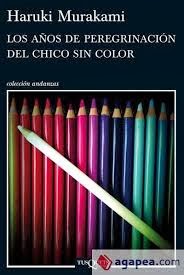
Announcements about the October 15 publication of the Spanish translation of the novel have started appearing on the internet. The translator's name is not mentioned... at least, we couldn't find it. Also, supposedly the publication was announced by the publisher, Tusquets Editores, but we could not find any information on the publisher's page (http://www.tusquetseditores.com/). It is worth noting that the Spanish title does not include "Tsukuru Tazaki" -- it can be translated as something like: The Years of Pilgrimage of a Colorless Boy.
It is possible to already preorder the book (for 18.95 euros): http://www.librerialuces.com/libro/los-anos-de-peregrinacion-del-chico-sin-color_445405
http://leyendolibros.com/portada/9788483837443.jpg
Here is one of the announcements:
La nueva novela de Haruki Murakami
'Los años de peregrinación del chico sin color', en España el 15 de octubre.
01 de agosto de 2013. Estandarte.com
Qué: Los años de peregrinación del chico sin color Autor: Haruki Murakami Editorial: Tusquets EditoresAño: 2013 Páginas: 328 Cuándo: 15 de octubre de 2013 Precio: 19,95 €
Los admiradores españoles de Haruki Murakami están de enhorabuena: Los años de peregrinación del chico sin color, su nueva novela, llegará a todas las librerías el próximo miércoles 15 de octubre. El título modifica el explícito original japonés,Shikisaiwo motanai Tazaki Tsukuru to kareno junreino toshi, que se traduciría comoEl descolorido Tsukuru Tazaki y sus años de peregrinación, y añade un poco de misterio al asunto.
Después de la publicación entre 2009 y 2010 —en 2011 en España— de su monumental trilogía 1Q84, que Tusquets Editores publicó en España en dos volúmenes, Haruki Murakami se ha tomado tres años para la escritura de esta novela. Los años de peregrinación del chico sin color es mucho más breve que su antecesora —poco más de trescientas páginas— y cuenta la historia de Tsukuru Tazaki, un arquitecto de 36 años especializado en diseñar estaciones de tren, cuya vida y cuya memoria se tambalean al conocer a Sara, una mujer algo mayor que él, que le recordará los felices años de la adolescencia y los infelices años de la juventud.
The whole story at: http://www.estandarte.com/noticias/libros/novela/los-anos-de-peregrinacion-del-chico-sin-color-de-haruki-murakami_1969.html
Visualizing translation #3
Anna Zielinska-Elliott writes:
In Chapter 15 of the novel, Tsukuru Tazaki travels to Finland and visits the small town of Hämmenlinna. Normally I would not have felt the urge to see the images of a town before translating its description, but there was sentence that I struggled with a bit. The protagonist is in a town square and sees a church on the other side of it. The church is described as 丸い緑の屋根を持ったずんぐりとした教会. (p. 266) Later, black birds appear and are busily flying 屋根から屋根へ --> from roof to roof? How many roofs could a single church have? Puzzled by this, I decided to look at at map of Hämmenlinna on Google Maps and see if I could locate a church near the main square. I am well aware, of course, that descriptions like this can be purely fictional, but still thought it might be worth a try. After finding a church (Hämeenlinnan kirrko) that bordered on the main town square, I changed to a street view mode. Here is the result:
From the picture, it does appear that Murakami is describing an actual church. Perhaps he has visited Hāmeenlinna himself? Looking at the photograph, it is in fact very easy to see how the birds could have been moving from one part of the roof to another part, i.e., "from rooftop to rooftop." Here is a bird's eye view:
http://kotisivu.dnainternet.net/ktuuna/lento_26.html
Saturday, July 20, 2013
What Gets Lost in Translation: Struggling with "Suddenly"
Blue Suddenly, Mira Schor drawing, http://en.wikipedia.org/wiki/File:Mira_Schor_Blue_Suddenly.jpg
Anna Zielinska-Elliott writes:
As I am working on the translation of Colorless Tsukuru Tazaki, I am reminded of what Edward Seidensticker wrote once in an essay titled, On trying to translate Japanese (in J. Biguenet and R. Schulte, eds., The Craft of Translation [Chicago: University of Chicago Press, 1989]):
I have spoken of oh's and ah's and blubbering. They bring us to the
essential fact that Japanese is a very wordy language. Let anyone
who does not think so try reading one of the bracket-school
translations: he will find innumerable drones wandering free. "Now
that is a fact" at the end of every sentence is one example; the
remarkable number of adverbs, the nearest English equivalent to
which is "suddenly," but which actually do not mean anything at
all, is another. (152)
While there are no "oh's" and "ah's" in Colorless Tsukuru Tazaki, I am finding myself struggling with how to translate the many different suddenly's. Unlike Edward Seidensticker, I am not suggesting that they don't mean anything, but simply that compared to Polish, Japanese has a lot of words meaning "suddenly." This means that many nuances of different "suddenly's," unexpectedly's" or "abruptly's" must get lost when translated. It must have been the case in all the books I have translated before, but for some reason I have only fully realized it now. Checking one of the online dictionaries, http://ejje.weblio.jp/, after putting in "suddenly" we get this impressive list:
驀地に;矢庭に;出しぬけだ;唐突だ;出し抜けだ;突然;ぱっと;急遽だ;カラッと;がばと;俄かだ;見る間に;頓に;やにわに;にょいと;行成り;ふいと;くっと;はっと;にょっと;がたっと;俄だ;行成;ぱたっと;見るまに;ころっと;突如;つと;がぜん;ついと;俄然;ひょいと;突として;忽たる;急に;疾く;突如たる;いきなり;ぽっと;からっと.
Anna Zielinska-Elliott writes:
As I am working on the translation of Colorless Tsukuru Tazaki, I am reminded of what Edward Seidensticker wrote once in an essay titled, On trying to translate Japanese (in J. Biguenet and R. Schulte, eds., The Craft of Translation [Chicago: University of Chicago Press, 1989]):
I have spoken of oh's and ah's and blubbering. They bring us to the
essential fact that Japanese is a very wordy language. Let anyone
who does not think so try reading one of the bracket-school
translations: he will find innumerable drones wandering free. "Now
that is a fact" at the end of every sentence is one example; the
remarkable number of adverbs, the nearest English equivalent to
which is "suddenly," but which actually do not mean anything at
all, is another. (152)
While there are no "oh's" and "ah's" in Colorless Tsukuru Tazaki, I am finding myself struggling with how to translate the many different suddenly's. Unlike Edward Seidensticker, I am not suggesting that they don't mean anything, but simply that compared to Polish, Japanese has a lot of words meaning "suddenly." This means that many nuances of different "suddenly's," unexpectedly's" or "abruptly's" must get lost when translated. It must have been the case in all the books I have translated before, but for some reason I have only fully realized it now. Checking one of the online dictionaries, http://ejje.weblio.jp/, after putting in "suddenly" we get this impressive list:
驀地に;矢庭に;出しぬけだ;唐突だ;出し抜けだ;突然;ぱっと;急遽だ;カラッと;がばと;俄かだ;見る間に;頓に;やにわに;にょいと;行成り;ふいと;くっと;はっと;にょっと;がたっと;俄だ;行成;ぱたっと;見るまに;ころっと;突如;つと;がぜん;ついと;俄然;ひょいと;突として;忽たる;急に;疾く;突如たる;いきなり;ぽっと;からっと.
Thursday, July 18, 2013
Dutch Translation of Colorless Tsukuru Tazaki to Appear in January 2014
Atlas Contact has announced the upcoming publication of the Dutch translation of Colorless Tsukuru Tazaki. The book is being translated by Jacques Westerhoven and is to appear on January 12, 2014 to coincide with the author's 65th birthday.
De kleurloze Tsukuru Tazaki en zijn pelgrimsjaren
Haruki Murakami
€ 19,95Niet beschikbaar
- Paperback
- ISBN 9789025442071
- januari 2014
- To see the whole ad go to the publisher's page: http://www.atlascontact.nl/boek/de-kleurloze-tsukuru-tazaki-en-zijn-pelgrimsjaren/
Subscribe to:
Posts (Atom)