Saturday, July 25, 2015

Another Review of Wind/Pinball and the Italian Translation of Men without Women

In her July 23 review of Wind/Pinball, which appeared in the Independent online, Arifa Akbar calls the novellas, "appetisers from the kitchen table," referring to the fact that Murakami wrote them at home late at night after getting back from work (this was many years ago, when he ran a jazz bar). Akbar's opinion of the language of the books differs greatly from Matthew Adams's, quoted in the previous post. She writes: "What stands out in both books is the writing, beautiful in its simplicity, and also the deadpan humour and one-liners." Here is a link to the review.

In other Murakami translation news, the Italian translation of Men without Women, by Antonietta Pastore, appeared last week. The Italian title Uomini senza donne also uses "women" in plural -- I am referring here to an earlier discussion about singular vs. plural in this title (see the posts of March 29 and March 6).

Thursday, July 23, 2015

The Introduction to Wind/Pinball Already Available Online

The introduction written by Murakami for Wind/PinballTwo Novels, which is being released by Knopf on August 4, is already available online here:
http://lithub.com/haruki-murakami-the-moment-i-became-a-novelist/
In it, Murakami talks about how he became a writer and puts his two earliest novels in a broader context by explaining their inception -- an interesting read!


And here is an early review by Matthew Adams:
http://www.thenational.ae/arts-lifestyle/the-review/book-review-windpinball-two-novels-by-haruki-murakami
The reviewer mentions the name of the translator, Ted Goossen, and says that the books are "a great treat," but then -- as is so often the case in these situations -- proceeds to comment on the writing style, seemingly oblivious to the fact that the words he read were Ted Goossen's, not Murakami's: "But anyone expecting a high standard of writing from these books will be disappointed. Their dominant mode is that of cliché: characters “sweat like a pig”; have “time to kill”; gaze with “bleary eyes”; complain that they are “dead tired”; endure rain that is “freezing cold”; sit in cars that are “stifling hot.”  There may be clichés in the original, but if you are going to comment on the use of clichés in a review of a translation from a language as different from English as Japanese, wouldn't it make sense  to refer to the fact that one is commenting on the language of the translation?

Saturday, July 11, 2015

"I very often feel I’m writing original—almost original—fiction" Says Jay Rubin About Translation

An interview with Jay Rubin by Nikkitha Bakshani recently appeared in the online literary magazine, The Rumpus. As regular readers of this blog will know, Rubin is a scholar of Japanese literature and one of the best-known American translators of Murakami; what some of you may not know is that he is also the author of a new novel, The Sun Gods. 

In the interview, occasioned by the publication of his novel, he explains how he became interested in Japanese and discusses his views of translation as "writing original -- almost original -- fiction."


Picture from Goodreads.com

I'm pasting the first question and Jay's answer to whet your appetites and hoping that The Rumpus will forgive me.


The Rumpus: What drew you to studying Japanese language and literature?
Jay Rubin: In my second year at the University of Chicago, I assumed I was going to be either an English or a Philosophy major, and I had about one free quarter where I thought, “Why don’t I do something non-Western, as this could be my last chance?” It just so happened that there was an Introduction to Japanese Literature course available in that quarter.
The professor would bring in not just the English translations that we were reading, but also the originals. He would read from the original and give literal translations. He gave the class a strong impression that as much as we were enjoying these translations, we’d enjoy them far more in the original.
I decided right there and then I was going to study Japanese. At the time, I was selling ice cream from a truck. I remember having my Japanese books with me, and on break, I would practice writing characters on banana skins.
To read the whole interview, go to: http://therumpus.net/2015/07/the-rumpus-interview-with-jay-rubin/

Here is also a link to Jay Rubin's recent review of Juliet Winters Carpenter and Mari Yoshihara's translation of Mizumura Minae's The Fall of Language in the Age of English. 

Tuesday, July 7, 2015

Greek, Icelandic and Croatian Translations of Tsukuru Tazaki

I have previously failed to note three new translations of Tsukuru Tazaki, all from last year.

The first is the Icelandic translation by Ingunn Snædal published by Bjartur.

The second one is the Croatian translation, which came out in November 2004 from Vuković & Runjić. The translator, Maja Šoljan, has translated a number of Murakami novels; her Croatian translation of After Dark, titled Kak padne mrak, won the 2009 Kiklop Prize for the "translation of the year." However, since she also seems to translate extensively from English (Jeffrey Eugenides, Alice Munro, Philip Roth, etc.), it is not clear whether the translation of After Dark was a direct translation from Japanese or an indirect translation from English. I have contacted the publisher and am waiting for their reply. 

The third new translation of Tsukuru Tazaki is the Greek version by Maria Argyraki, which appeared last October from Psychologios.


Thursday, May 28, 2015

The New York Times Review of Murakami Audio Books

On May 15, the NYT Book Review published a review of the audiobook versions of The Strange Library and Colorless Tsukuru Tazaki and His Years of Pilgrimage. The review is by Daniel Handler, a novelist, who writes that the audio versions "turn out to be the perfect way to experience this strange entry into Murakami's own strange library." (You can buy the audiobooks here or here - Audible.com, shown in the pictures.)

Handler notes that there is "no discernible reason I have devoured every one of his [Murakami's] books, often late into the night. And I am hardly alone," but by the end of the piece he comes up with a statement that, in my opinion, quite aptly expresses the charm and quality of Murakami's writing:


"Murakami does not conform to our ideas of plot or structure, nor does his language conform to any admirable characteristic; he does not conform to expectations about Japanese literature, or translated literature, or arguably even literature at all. All he conforms to is our expectations of Haruki Murakami, and it may be that this little puzzle — equal parts logic problem and joke — is exactly what makes him so mesmerizing."

However, what is most unusual about this review is that it repeatedly refers to translation. As most translators reading this will know, it is rare to find any mention of translation in most reviews of Murakami; reviewers feel at liberty to comment at length on Murakami's style, seemingly unaware that they are not, in fact, reading the original, but a translation, and that what they are really commenting on is the style of the translator.

Handler does not commit this error.  When listening to readings of the books, Handler is quite well aware that what he is hearing are not Murakami's words, but the the words of Ted Goossen and Phil Gabriel, respectively. When talking about Murakami's writing style, he says:

            As for his language — well, most of us New York Times readers are receiving Murakami in 
            translation, but even so there’s little to indicate we’re missing some grand linguistics in the original. 
            His language is accessible, plain-spoken, even banal, perhaps purposefully so.


He follows with this statement:
           Of course, it can be argued that reading Murakami in English — as with any author in translation — 
           is inevitably a filtered experience, and that the act of translation has already interfered with the 
           genuine text. Certainly I’ve puzzled over this — my favorite Murakami novels were all translated by
           Alfred Birnbaum, but who knows what that means? 


This is clearly a thoughtful reviewer! We wish there were more like him.

His comment, that the reason he may have liked Alfred Birnbaum's translations may have had to do more with Birnbaum's style rather than Murakami's, reminds us of an essay by Wendy Lesser, "The Mysteries of Translation," in which she also says she prefers Birnbaum's version of Norwegian Wood to Jay Rubin's translation. If you are a subscriber to The Chronicle of Higher Education, you can find her essay here.  If not, you can always read her book, Why I Read, where she writes about the same issue in Chapter 6.


Another option for those wishing to compare the style of the two translators would be to look at the first chapter of Wind-Up Bird Chronicle, translated by Rubin, and the short story, "The Wind-Up Bird and the Tuesday Women," from The Elephant Vanishes, translated by Birnbaum.


Thursday, May 21, 2015

Two earliest Murakami novels out in German yesterday! In English in August!

Murakami's first two novels (novellas?) Kaze no uta o kike (1979) and 1973 nen no pinbōru (1980) came out in German yesterday in Ursula Gräfe's translation. The publisher is Dumont Buchverlag. Here is a picture of the cover, reminiscent of the other recent German Murakami covers.


Also, an announcement appeared on the Random House page about the August 4, 2015 publication of the new English translations of the same books by Ted Goossen. As mentioned earlier in this blog (the post from 14 September 2014), both appeared in Japan in the 80's in Alfred Birnbaum's translation, published by Kodansha.  As you can see on the cover, the titles seem to have been shortened to just Wind and Pinball.  Or perhaps this is just on the cover?

The same two novellas have already appeared in Chinese, Dutch, Korean, Polish, and Russian.  If I am missing a translation, please let me know. It strikes me that there is a funny cyclical quality about the recent, almost simultaneous, posts referring to Haruki Murakami's very latest -- and very oldest -- works, 35 years apart.


"The debut short novels--nearly thirty years out of print-- by the internationally acclaimed writer, newly retranslated and in one English-language volume for the first time, with a new introduction by the author.

These first major works of fiction by Haruki Murakami center on two young men--an unnamed narrator and his friend and former roommate, the Rat. Powerful, at times surreal, stories of loneliness, obsession, and eroticism, these novellas bear all the hallmarks of Murakami's later books, giving us a fascinating insight into a great writer's beginnings, and are remarkable works of fiction in their own right. Here too is an exclusive essay by Murakami in which he explores and explains his decision to become a writer. Prequels to the much-beloved classics A Wild Sheep Chase and Dance Dance Dance, these early works are essential reading for Murakami completists and contemporary fiction lovers alike."

And here are the covers of Goossen's translation for the UK edition, featured on the amazon.co.uk page:


The publication date is also August 4, 2015.

Sunday, May 17, 2015

"The Magical Art of Translation" at the Japan Society

On May 7, the Japan Society sponsored a public forum on Murakami Haruki, translation, and writing. Held at the Society's offices in New York City, the discussion included Jay Rubin (scholar, Murakami translator, and recently a novelist, with a novel titled The Sun Gods, coming out on June 2 from Chin Music Press), Ted Goossen (scholar, critic, and Murakami translator), Motoyuki Shibata (renowned translator of American literature and the editor of Monkey Business), Aoko Matsuda (writer and translator), and Satoshi Kitamura (writer and illustrator). Roland Kelts moderated. 

Participants shared their opinions about Murakami, the process of translation, and their thoughts on reasons behind Murakami's popularity. Matsuda said that she considered translating an activity very similar to writing and not in any way inferior. Kitamura suggested that illustrating was similar to translation, a view seconded by Shibata, who believed, for example, that his translation of Stuart Dybek's poem did not manage to fully transmit the spirit of the original until it was accompanied by Kitamura's illustrations. (This made me think again about The Strange Library and all the different illustrations discussed last month in this blog.) Ted Goossen talked about his first phone conversation with Murakami and Jay Rubin about the shift from translating to novel writing. 

Jay Rubin also said the following about translation: "[T]here is a large part of it that you can't really explain. It happens as you wrestle with one language, trying to get it into the other language. And you're not just taking grammatical forms from one language and mechanically transferring them into the other. There's something unusual going on. There is something..." [Roland Kelts: "It is creative. I mean, isn't it?"] "It is not creative." [Roland Kelts: "It is not creative?"] "No, it is not. People try to use that term about translation. I don't believe you can use it."

Hmm.... If we can say that translation is an art -- which Jay acknowledged a minute earlier in the interview -- does that not mean it involves being creative? 

Here is the video of the discussion:


The Magical Art of Translation: From Haruki Murakami to Japan's Latest Storytellers

https://www.youtube.com/watch?v=U4qtvGTaRto

This event was part of an annual series of literary events which have been organized for the last five years around the publication of the English version of Monkey Business, a literary magazine published by Shibata Motoyuki (the Japanese original was later renamed as simply Monkey).

In fact, a number of earlier discussions in this series can be found on YouTube. Here is a link to a fascinating one from 2012, featuring Shibata, Goossen, Kawakami Hiromi, and Rebecca Brown, among others:
https://www.youtube.com/watch?v=-wDc6yaSb9o

Wednesday, May 6, 2015

More on Singular or Plural, and on Womanless Men

When I wrote my previous post (3/29) about how to translate the title Onna no inai otokotachi, I mentioned that Haruki Murakami said in the preface to the anthology that, despite appearances, the title of his book is not meant to be a translation of the title of Hemingway's 1927 anthology, Men Without Women.  He also mentioned that Hiroshi Takami translated the title as Otoko dake no sekai (A man's world?). At the time, it did not occur to me to see whether any other, earlier Japanese translations existed. Having now checked, I have made two discoveries:  first, there are two other Japanese translations, and second, in both cases, Onna no inai otokotachi is, in fact, precisely the title used.

Here are the three covers. The first is Hiroshi Takami's translation published by Shinchosha in 1995. The second is the 1977 translation by Katsuji Nakamura, published by Kodansha. The third, by Nobuo Ayukawa, came out from Kochi Shuppansha in 1982. Given that everyone knows how familiar Haruki Murakami is with American literature, I am afraid that no matter what he says in the preface to his anthology people will inevitably make the connection to the anthology of Hemingway...


Here are two more translations of Onna no inai otokotachi. 


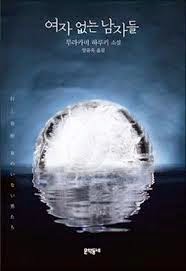
This is the Korean version, which came out in August, 2014, in a translation by Yang Ŏk-Kwan. Having consulted with my Korean colleague, I believe that the title is pretty much a literal translation of the Japanese one. The word "onna" (or its Korean equivalent, yeoja 여자) can be singular or plural (as in the Japanese), and the word "otokotachi" (namjadeul 남자들) is plural (also as in the Japanese). 


And this is the 2015 Catalan edition in Albert Nolla Cabellos's translation. The title means "Men Without Women."

Tuesday, April 28, 2015

The Portuguese Version of "Sleep"

Maria João Lourenço, the Portuguese translator of Murakami, read the previous post and made me realize that I had failed to mention the Portuguese edition of Sleep, which came out in 2013 in her translation (sorry and thank you, Maria João!). The Portuguese edition also includes Kat Menschik's illustrations. Here is a picture of the cover.


Sunday, April 19, 2015

More on Translating Images and The Strange Library

When talking about translations of Murakami and illustrations, one has to mention the German illustrator Kat Menschik (in the picture below), who worked on The Strange Library, among other Murakami writings. The drawing on the right shows Murakami and Menschik together (although she doesn't look like herself...).


In the previous post, I wrote about the illustrations in the British and American version of The Strange Library.  The story came out in German a year earlier, in 2013, in Ursula Gräfe's translation, Die Unheimliche Bibliothek, illustrated by Menschik. Menschik had earlier done the illustrations for three other Murakami stories: Schlaf ("Sleep," 2010, translated by Nora Bierich)  and Die Bäckereiüberfälle (which consists of two short stories, "The Bakery Attack," and "The Second Bakery Attack," 2012, translated by Damian Larens). While the first of these (The Strange Library/ Fushigi na Toshokan) was also an illustrated book in Japanese, the other three stories were not, and appeared in short story anthologies.


It would be worth thinking about the relationship between illustrations and the translated text: What new qualities do they add to the story? Do they detract from the story or help us enjoy it more? Do they make concrete something the author intended to leave vague?  In the case of stories that were originally accompanied by illustrations, why not use those? Do illustrations have to be "translated," too?  In the case of stories that originally lacked illustrations, what does it mean to add that element? 

Menschik's illustrations, as is already clear from the cover of the Die Unheimliche Biblioteque, are quite different in style from the original ones by Maki Sasaki. Below left is a picture showing both editions of The Strange Library. On the right is an illustration of the German version of Sleep, which was not illustrated in the original. 


All three stories were re-published in Japan with Menschik's illustrations. What is interesting is that the title of the Strange Library went back to the original 1982 title, Toshokan kitan (Strange Tales of a Library), and the title of Bakery Attacks ("Pan'ya Shūgeki" and "Pan'ya saishūgeki") became something like "To Attack a Bakery (or Bakeries)" ("Pan'ya o osou"). It may be the case, of course, that the Japanese version IS in fact a new edition of the original story, which was much longer. (I will order it and report.) Below are the only two illustrations included with "Toshokan kitan" in the 1983 anthology, titled Kangarū-biyori:


Below are the covers of the Japanese editions of Toshokan kitan (2014, Strange Tales of a Library), Pan'ya o osou (2013, To Attack a Bakery) and Nemuri (2010, Sleep), all with Menschik's illustrations:


Menschik's illustrations clearly are admired by many, since the Spanish edition of the Strange Library (or rather: Secret Library) (2014, Lourdes Porta, tr.) and the French edition of Bakery Attacks (2012, Corinne Atlan, Hélène Morita, tr.) also used her images:


The same is true of the story Sleep, which came out with Menschik's images in French (2010, Corinne Atlan, tr.), Spanish (2013, Lourdes Porta, tr.), and Italian (2014, Antonietta Pastore, tr.) It is worth noting that in both Spanish translations Lourdes Porta got her name on the cover!