Thursday, July 30, 2020

The Mystery of the Ace of Spades and Dance, Dance, Dance in Turkish

Good news for Turkish readers! Ali Volkan Erdemir's translation of Dance, dance, dance was just published by Doǧan Kitap.

Volkan shares below some thoughts about his experience with this translation:

"I have been translating Murakami's works into Turkish since 2015 and Dance Dance Dance is my tenth translation. Published in 1988, it is one of my favorites. While translating, I felt connected most of the characters such as "boku," Yuki, and Dick North, but the Sheep Man is always special for his pure heart. Just as the Sheep Man finds peace in his own world, I find peace in Murakami's world. Hopefully my bond will always continue with future translations."

In this same e-mail, Volkan mentioned that he would be translating Pinball, 1973 next. This reminded me of some translation-related problems I ran into when I working on that book, which required me to contact a number of Polish pinball aficionados for help with terminology for different parts of pinball machines. Never having played pinball before, I also went to an arcade to be able to see for myself how pinball machines work (it turns out I was not very good!). And as I was reading about different types of machines in the novel, I searched for some of them by name on the Internet to see what they looked like. Here I ran into a problem with the ace of spades.


 Here is the problematic passage in question, in two English translations:

Alfred Birnbaum (1985):
"Kings and Queens," a model with eight roll-over lanes.  A beautifully mustached, crewcut, nonchalant-looking Western gambler, with an ace hidden behind his spur."

Ted Goossen (2015):
"Gottlieb's Kings & Queens, the model with eight rollover lanes. It featured a Western Gambler with a manicured mustache, a nonchalant expression, and an ace of spades tucked in his suspenders."

In the original Japanese the second sentence says, "Kuchihige o kirei ni kariageta noncharan na kaotsuki no seibu no gyanburā, kutsushitadome ni kakushita supēdo no ēsu."

Literally, this gives us something like, "A Western gambler with a beautifully trimmed mustache, a nonchalant expression, and an ace of spades hidden in (or: under) [his] sock garter."

So where exactly is the ace of spades? 

Let's look at a picture of the machine in question, which shows three none-too-honest players involved in a game of poker:


It appears that the gambler seated in the purple jacket has an ace of hearts hidden in his right sleeve, but if he is wearing sock garters, or suspenders, or spurs, these are nowhere in sight. Looking around the table, though, we indeed find the ace of spades -- hidden in the cleavage of the blonde on the left! 

In such a situation -- where it appears that the author's memory has deceived him -- what should a translator do? Change the text to accord with the image on the machine? Leave it alone and hope that no one catches the mistake? Provide a footnote? (I left it alone in the Polish translation, which came out in 2014, translating the passage as "hidden in his garter," which the editor later changed to "hidden in his sock," feeling that reaching up two one's garter to extract the ace would be too noiticeable)

This experience also reminds me what a difference the Internet makes in a translator's life. When Alfred Birnbaum was translating the book thirty-five years ago, he had no option of just Googling the machine in question. He could only frequent game arcades in the hopes of spotting one, following Boku's example. 

Saturday, July 18, 2020

The New Short Story Anthology Is Out

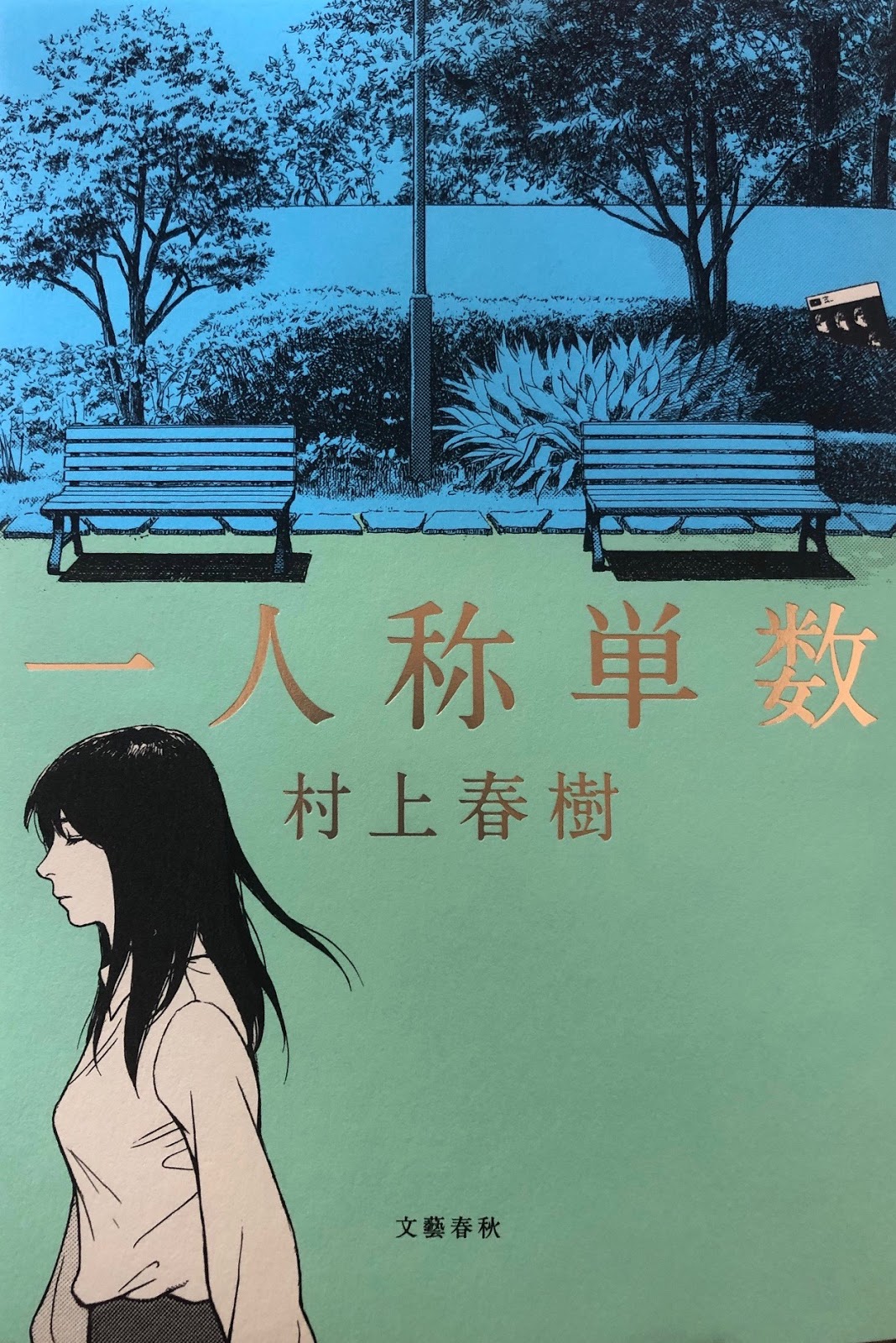
The new short story anthology by Haruki Murakami, titled Ichinishō Tansū (First Person Singular), published by Bungei Shunjū, appeared on July 18 in Japan. Note the clever cover design with the same motif repeated on the obi


As I mentioned in an earlier post, seven of the eight stories have appeared previously in Bunkakukai (four of them are available in English). The last story in the anthology, however, is new -- and the collection bears its title. One wonders if the title might be a reference to John Updike's series of essays about his boyhood and youth published in Assorted Prose. They have also appeared in Japanese translation in 1977 (see the image below).


Speaking of John Updike, there is a charming super short story by Murakami called "Jon Apudaiku o yomu tame no sairyō no basho" (The Best Place for Reading John Updike), published in 1986 in Zōkōjō no happiiendo (The Happy End of the Elephant Factory). 


The new Murakami stories are all written in the first person singular; many are reminiscences from his childhood or college years. Interestingly enough, seven of the eight are written by Boku (first person singular pronoun, used mostly by males), and one is written by Watashi (the most universal first person singular pronoun). Also, six of the seven Bokus use kanji to write "boku," while the seventh uses hiragana. One imagines that this difference between pronouns is something that will most likely get lost in translation.
Another potential challenge for translators is that two stories ("Ishi no makura ni" (On a Stone Pillow) and "Yakuruto Suwarōzu shishū" (The Yakult Swallows Poetry Collection) include poems - in the first one we find a number of poems in the classical Japanese form of tanka; in the second - free verse).  

Monday, June 29, 2020

A Great New Book on English Translations of Murakami

 I want to recommend an excellent book which will be coming out on September 1 from Soft Skull Press: Who We're Reading When We're Reading Murakami, by David Karashima. This is a rewriting of a similar book David published in Japanese in 2018, under the title Haruki Murakami o yonde iru toki ni wareware ga yonde iru monotachi. The English version covers much the same territory, but is in a way a whole new book. Here are the two covers:


The title -- both titles -- are an obvious reference to Murakami's book about running (What I Talk about When I Talk about Running), which in turn is a reference to Carver's story, "What We Talk about When We Talk about Love," translated by Murakami. Notice that the Japanese title not only gives Murakami's name in English, but also in the English order (given name first), unlike in Japanese. This is because the book is about Murakami in English. It tells the story of how Murakami's early works were edited, cut, and molded to make him a success in the West - an approach that clearly paid off. David interviewed the main characters involved in this enterprise: translator Alfred Birnbaum and editor Elmer Luke (who used to work for Kodansha International). He also talked to the British editor, to editors at Knopf and The New Yorker, to Jay Rubin, and many others. The book is eye-opening, enabling one to better understand how Murakami became the literary star that he is in the West. It's also a great read.

David Karashima teaches creative writing at Waseda University in Tokyo. He has translated a numbr of Japanese writers, including Hitomi Kanehara, Hisaki Matsuura, and Shinji Ishii.

Sunday, June 7, 2020

New Murakami Short Story Anthology To Come out in July

It has been announced that a new short story anthology by Haruki Murakami, titled Ichininshō tansū  [First person singular] will be published on July 18, 2020 in Japan. This will be the first Murakami story collection in six years, since Men without Woman. Apparently, it will include seven short stories published in the literary magazine Bungakukai during 2018 and 2019, and at least one new story - perhaps the title one?  

Four of the stories have already appeared in English translation. "Cream," "With the Beatles," and "Confessions of the Shinagawa Monkey" were published in The New Yorker. The first one appeared in the January 18, 2019 issue (you can find it here), the second one in the February 17-24, 2020 issue (you can find it here), and the last one in the June 8-15, 2020 issue (you can find it here). A fourth story, "Charlie Parker Plays Bossa Nova," appeared in Granta 148, August 1, 2019 (you can find it here). All have been translated by Philip Gabriel. 

The book may be pre-ordered on Amazon Japan here. So far, the cover has not been released. 

Wednesday, May 27, 2020

James Westerhoven Wins an Important Translation Award


I have not posted in months - but not for lack of material! Sometimes, things just don't happen for no good reason. The coronavirus didn't help, either. But there is one post I have been meaning to write for a few months because it concerns a fellow Murakami translator who has contributed his thoughts to this blog in the past.

James (Jacques) Westerhoven, the leading Dutch translator of Murakami (and many other writers), won the 2020 Martinus Nijhoff Translation Award, the most prestigious translation award in the Netherlands and Belgium. The award ceremony was to take place in March, but was moved to September, due to Covid 19.


The Wikipedia page for the award says that James won the prize for his translations from Japanese, including those of Haruki Murakami and Jumpei Gomikawa. The prize was established in 1953 in memory of the poet and translator, Martinus Nijhoff, and has been awarded since 1955. It seems that the last time the prize was given for translations from Japanese was 1985. 

The jury had this to say about James (I am relying on Google Translate here): "'Translating exactly what the text says' is certainly not Westerhoven's motto, even though he does translate what it says, but he does it in the appropriate key and with the necessary modulation. With his translations, his afterwords and articles, Jacques Westerhoven has done an invaluable service both to Japanese literary culture and to the Dutch readership."

Below are some (not all) of James's translations of Murakami Haruki.


As I was looking on the internet for James's translations, I came across this cover (right). It is Een stoomfluit midden in den nacht (Steam Whistle in the Middle of the Night), which is the title of one of the short shorts from Murakami's 1995 collection Yoru no kumozaru (Spider Monkey of the Night). The book includes that and two more stories English language readers won't find anywhere: "Kanō Kureta" (Creta Kanō, 1990 - the same name as the character from The Wind-Up Bird Chronicle) and "Futago to shizunda tairiku" (Twins and the Sunken Continent, 1985 - the same twins as the ones that appear in Pinball, 1973). What a treat for Dutch readers! Although perhaps not all readers? I have found a blog online where the author says that the book "was a New Year's gift of a group of Dutch publishers. Not for sale." Perhaps James can shed some light on this?

Besides Murakami, James has translated a variety of writers including Junichiro Tanizaki, Kenzaburo Oe, Yukio Mishima, Jumpei Gomikawa, and Yasushi Inoue. He has also translated Osamu Dazai and Jiro Nitta into English. 

Here are some covers of James's non-Murakami translations.


Once again, Congratulations, James!

Wednesday, August 7, 2019

Commendatore in Norwegian, Turkish Birthday Girl, and Kat Menshik

I hope the Norwegian translators will forgive me that this announcement comes a few months late.  Killing Commendatore came out in Norwegian from Pax this spring. The book was translated by Ika Kaminka and Yngve Johan Larsen. It was not their first collaborative translation. I have to say that I am fascinated by the idea of working on a translation together with somebody else. It seems that such collaboration is in fact fairly common and may take different forms. I have only engaged in it once and found it quite challenging.  In 2002 or 2003 I was asked to translate the second part of Norwegian Wood into Polish. The first half had been done by Dorota Marczewska. I read her half, and then proceeded to work on the second half, but as I was translating, I was very aware that the text I was producing was coming out quite differently. After I finished, I was asked to make sure that the two parts fit. Dorota was not available to help for personal reasons, so I ended up having to make many decisions I wasn't sure she would approve of. As a result of this experience, I am very impressed by translators who seem to pull it off seemingly effortlessly. I believe that Ika and Ingve worked by translating alternate chapters and later making sure that the whole reads smoothly.  


Another new translation I wanted to mention is the Turkish translation by Ali Volkan Erdemir of the short story Birthday Girl. The book uses illustrations by Kat Menshik, who has also illustrated the German versions of The Strange Library (I wrote about it on this blog here), Sleep, and The Bakery Attack. Her illustrations were later used in several language versions.

https://t24.com.tr/k24/yazi/murakamik-bag,2293


Also, in case of Birthday Girl Menshik's illustrations were used in many language versions. Here are four of the covers: German, French, Spanish, and Korean


Ali Volkan Erdemir interviewed Menshik in January 2019. You can read the whole interview here.
If we can trust Google Translate, Menshik talked about her use of color among other things.  She said she picks two basic colors for each story.  Midnight blue and silver seemed like "the most sensible choice" for Sleep, she chose dark green and brown (or "bronze"?) for The Bakery Attack. For The Birthday Girl she chose three: red, pink and orange.


Menshik did not talk about it in the interview, but it seems that she picked black and off-white as the themes for the The Strange Library, with occasional brown and red. 


As I wrote 4 years ago in a blog post about Menschik's illustrations of that last book, illustrations - together with the cover become an important element of the translation. In most cases the translator does not get to express an opinion about the cover or illustrations in the book, and it is easy to imagine that his or her visualization of the story would differ greatly from the cover designer's or illustrator's. And possibly also of the author's. Menschik presumably works on her illustrations inspired by the German translation. Is there some quality in the German translation that inspire certain kinds of illustrations? Do the illustrations then match other language versions?

The situation becomes even more complicated if the original story was illustrated, as was the case with the original of The Strange Library. Here is a picture from the original Japanese publication:


We know from interviews though, that Murakami likes Menschik's illustrations. In fact, all stories illustrated by her were later republished in Japanese using her images. Presumably, Murakami must have approved the original illustrations by Maki Sasaki, which suggests that the author approves of a variety of visual responses to his stories. In case of The Bakery Attack the title was slightly altered to say Pan'ya o osou ["To Attack a Bakery" or "Attacking a Bakery"], and with The Strange Library, the title used was the title of the original 1982 story, Toshokan kitan ["Strange Tales of a Library], rather than the 2005 Fushigi na toshiokan ["The Strange Library]. It was advertised in Japan as an "art book with a new feel."